





27 June 2026
Introduction
The association between smoking and lung cancer is so well-established that it has created a clinical blind spot: the assumption that a non-smoker presenting with respiratory symptoms is at low risk and can be reassured without investigation. That assumption is wrong, and it is costing lives. Lung cancer in non-smokers accounts for approximately 10–15% of all lung cancer cases globally, a proportion large enough that if it were counted as a separate disease, it would rank among the ten most common cancers worldwide. In India, environmental risk factors for non-smoker lung cancer are not merely theoretical, as air pollution levels in major cities regularly exceed WHO safety thresholds by multiples and radon testing in homes is rarely performed. The result is a population of patients who arrive late to diagnosis because neither they nor their treating physician considered lung cancer a likely possibility. Understanding the genuine risk factors, the relevant lung cancer signs in this population, and what constitutes an appropriate early lung cancer examination is the clinical correction that this misconception requires.
Overview: Why Non-Smoker Lung Cancer Is Different
Lung cancer in non smokers is not simply smoking-associated lung cancer that occurs in someone who did not smoke. It has a distinct molecular profile. Adenocarcinoma, a subtype of non-small cell lung cancer, is the predominant histology, accounting for the majority of non-smoker cases. More importantly, non-smoker lung cancers are more likely to harbour targetable driver mutations EGFR mutations (particularly common in Asian women), ALK rearrangements, ROS1 fusions, and RET rearrangements. These mutations define a population of patients for whom highly effective targeted therapies exist therapies that work significantly better than standard platinum-based chemotherapy. Getting to that treatment, however, requires first getting to the diagnosis, which requires overcoming the misconception that non-smokers don't need lung cancer on their differential.
Risk Factors in Non-Smokers
Secondhand smoke
Decades of epidemiological data confirm that regular household exposure to tobacco smoke increases lung cancer risk by approximately 20–30%. A lifetime lived with a smoking partner or in a household where indoor smoking was the norm constitutes genuine occupational-level carcinogen exposure. This is the most common and most underacknowledged risk factor in women presenting with lung cancer in non-smokers in India.
Radon gas
Radon, a naturally occurring radioactive gas produced by the decay of uranium in soil and rock, accumulates in poorly ventilated indoor spaces and is the second leading cause of lung cancer in several high-income countries, accounting for approximately 3–14% of total cases depending on geographic region. It is odourless and invisible, and is detected only by testing. Most Indian households have never been tested. The lung damage mechanism is identical to that of tobacco smoke: alpha particle radiation from radon decay products causes direct DNA damage to bronchial epithelial cells.
Air pollution
The International Agency for Research on Cancer classified outdoor air pollution as a Group 1 carcinogen for lung cancer in 2013. Fine particulate matter (PM2.5) present at consistently dangerous concentrations in Delhi, Mumbai, Kanpur, and most major Indian cities penetrates the alveoli and induces chronic pulmonary inflammation and DNA damage. Long-term residence in high-pollution urban environments is now a quantifiable lung cancer risk factor, particularly for adenocarcinoma. This issue is not a peripheral concern in India; it is a major contributor to the non-smoker's lung cancer burden.
Occupational exposures
Asbestos, arsenic, chromium, nickel, diesel exhaust, and crystalline silica are all established lung carcinogens with significant occupational exposure in Indian manufacturing, construction, and mining sectors. Workers in these industries who have never smoked carry a lung cancer risk that is clinically meaningful and that warrants periodic surveillance, a conversation that happens far less often than it should in occupational health settings.
Genetic susceptibility and driver mutations
First-degree relatives of lung cancer patients have approximately a twofold increased risk regardless of smoking status. Germline mutations in genes including EGFR, TP53, and STK11 confer direct susceptibility. In non-smokers, the higher prevalence of targetable somatic driver mutations suggests a different carcinogenic pathway from the tobacco one in which genetic susceptibility plays a larger relative role. This finding is clinically relevant a non-smoker with a family history of lung cancer and a new respiratory symptom should be evaluated with the same urgency as a heavy smoker with the same symptom.
Lung Cancer Symptoms That Require Investigation in Non-Smokers
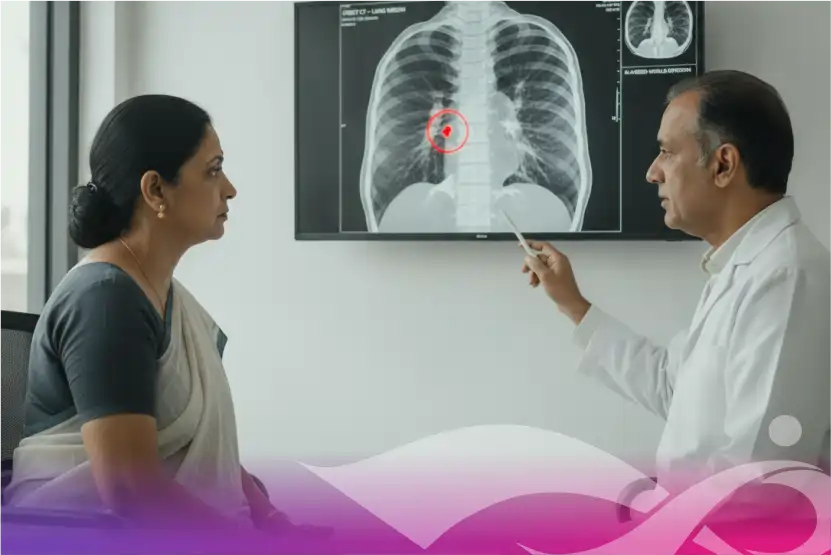
The lung cancer signs in non-smokers are identical to those in smokers: persistent cough lasting more than three weeks, haemoptysis (coughing blood) at any quantity, unexplained breathlessness, chest pain that is pleuritic or persistent, hoarseness without a clear cause and unexplained weight loss. The problem is not that the symptoms are different it is that in a non-smoker they are less likely to trigger imaging. A non-smoker with a three-week cough is more likely to be treated empirically for post-viral cough, GERD, or post-nasal drip than to be referred for a chest X-ray. Each of these diagnoses may be correct; the issue arises when the cough does not resolve after empirical treatment and imaging is still not obtained. The three-week threshold for chest imaging in any patient with unexplained persistent cough should apply regardless of smoking history.
Why Early Lung Cancer Diagnosis Changes Everything
Five-year survival for stage I non-small cell lung cancer is 80–90% with surgical resection. For stage IV disease, it is below 10% with standard chemotherapy, though targeted therapies for EGFR-mutated and ALK-rearranged disease have significantly improved median survival in this population. The gap between these outcomes is determined almost entirely by the stage at diagnosis, which is determined by when imaging is obtained. Early lung cancer diagnosis in non-smokers is not conceptually different from early diagnosis in smokers. Low-dose CT scanning identifies nodules that chest X-ray misses, and systematic follow-up of incidental pulmonary nodules with a validated protocol (Lung-RADS or Fleischner criteria) determines which require biopsy. The barrier is clinical non-smokers are rarely referred for low-dose CT screening because current screening guidelines are built around smoking history. This is a gap that clinicians with a high index of suspicion can partially address for symptomatic patients.
Treatment: Why Molecular Profiling Matters for Non-Smokers
Non-smoker lung cancers are more likely to harbour targetable mutations than smoker-associated cancers, which means that treatment decisions that do not include molecular profiling systematically deny this population their most effective treatment option. EGFR-mutated NSCLC responds to osimertinib with progression-free survival that platinum-based chemotherapy does not approach. ALK-rearranged disease responds dramatically to alectinib or brigatinib. These are not experimental options; they are standard first-line treatment for patients with these alterations. Getting molecular profiling done as reflex testing at diagnosis rather than waiting for chemotherapy failure is the clinical standard that a good lung cancer hospital in Delhi will apply as a matter of protocol.
Expert Tips for Non-Smokers Concerned About Lung Health
-
Do not dismiss a cough lasting more than three weeks because you have never smoked — smoking history does not determine imaging threshold; duration and persistence do, and a chest X-ray is a low-barrier first investigation.
-
Test your home for radon if you live in a ground-floor or basement property — radon test kits are inexpensive, the test requires no specialist involvement, and elevated radon is one of the few risk factors for lung cancer that is fully addressable by remediation.
-
Share your family history of lung cancer with your doctor explicitly — it changes the clinical threshold for investigation in a symptomatic non-smoker and is information that will not be volunteered if it is not provided.
-
Request molecular profiling at the time of any lung cancer diagnosis — do not accept treatment planning without it; the subset of non-smoker lung cancers with targetable driver mutations is large enough that untested treatment is potentially suboptimal.
-
Recognise haemoptysis as urgent regardless of smoking status — coughing any quantity of blood requires same-day or next-day clinical assessment and chest imaging; it is not a symptom to monitor at home.
-
Ask about occupational exposure history when seeing a respiratory specialist — asbestos, diesel exhaust, and silica exposure may not be volunteered by the treating physician; it is worth raising directly if your work history includes relevant industries.
-
Choose a lung cancer hospital in Delhi that offers reflex molecular testing and multidisciplinary tumour board review — these are the two structural features most strongly associated with optimal treatment decision-making in lung cancer; ask specifically whether they are standard practice rather than available on request.
Conclusion
Lung cancer in non smokers is not a rare exception it is a common, underdiagnosed disease with a distinct molecular profile, a set of identifiable environmental and genetic risk factors, and highly effective treatment options for a significant proportion of patients, provided the diagnosis is made at a stage when those options are available. Recognising the relevant lung cancer signs, not attributing them to low risk on the basis of never having smoked, and pursuing early lung cancer diagnosis with appropriate imaging and molecular workup are the clinical standards this population deserves. For expert evaluation, molecular profiling, and multidisciplinary lung cancer care, consult experienced specialists at a trusted lung cancer hospital because in this disease, the assumption of low risk in a non-smoker is the most consequential diagnostic error there is.