





30 July 2026
Introduction
Forty is a meaningful turning point for cancer risk. Several cancer types become significantly more common from this age onward, and screening guidelines shift accordingly. Yet a lot of people are genuinely unsure exactly what they should be getting tested for, and how often, once they cross this threshold. This is a clear, practical breakdown of what regular health screening after 40 should actually involve.
Overview
Preventive oncology is built on a simple principle: catching cancer before symptoms appear gives dramatically better treatment outcomes than catching it after. After 40, the recommended screening schedule becomes more structured and more frequent for several cancer types, reflecting the genuine rise in risk that comes with age.
Recommended Screening by Type and Frequency
Breast cancer (women) Mammography annually from age 40, alongside regular clinical breast examination. Women with a family history may need to start earlier, sometimes a decade before the age their relative was diagnosed.
Cervical cancer (women) Pap smear combined with HPV testing every three to five years between ages 21 and 65, depending on previous results and risk factors.
Colorectal cancer Colonoscopy every five to ten years starting at age 45, or earlier with family history. Stool-based testing is an alternative option for those who prefer it, done more frequently.
Prostate cancer (men) PSA blood testing annually from age 50, or from 45 with a family history, discussed with your doctor given the nuanced nature of prostate cancer screening decisions.
Lung cancer Low-dose CT scanning annually for long-term heavy smokers between ages 50 and 80, as defined by specific smoking history criteria.
Oral cancer Annual oral cavity examination for all adults, with particular importance for tobacco users of any kind.
Skin cancer Annual skin examination by a specialist, more frequently if you have multiple moles, fair skin, or a personal or family history of skin cancer.
Why Regular Screening Matters After 40
The honest reality is that risk for several cancer types climbs meaningfully after 40, and many of these cancers are entirely asymptomatic in their earliest, most treatable stages. A structured screening schedule is the only reliable way to catch these cancers at the point where treatment is simplest and outcomes are best. Waiting for symptoms before getting screened defeats the entire purpose of preventive screening.
Choosing the Right Screening Centre
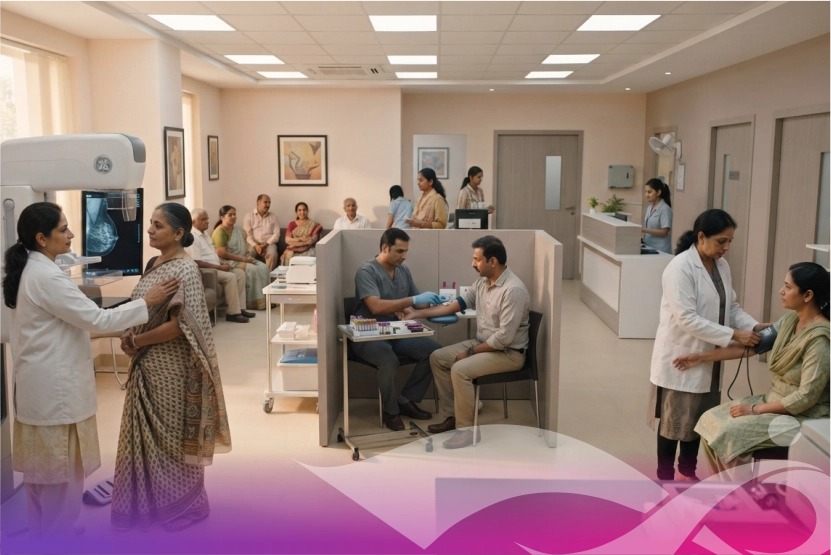
A proper cancer screening center in India offers a comprehensive, age-appropriate panel rather than a single isolated test, along with clear guidance on what your specific results mean and what follow-up, if any, is needed. This matters because screening that is scattered across different unconnected providers often leads to gaps or unnecessary duplication.
Tips and Expert Advice
-
Discuss your personal and family history with your doctor to determine if you need to start screening earlier than standard guidelines suggest
-
Keep a simple personal record of what screenings you have had and when, so nothing falls through the cracks
-
Do not skip a screening just because you feel completely well — that is precisely the point of screening
-
Ask your doctor to build you a personalised screening calendar covering all relevant cancer types for your age and risk profile
-
Treat an abnormal screening result as a prompt for further investigation, not an automatic diagnosis
Frequently Asked Questions
Q: Do I need all these screenings every single year? No, frequency varies by test. Some, like mammograms, are annual, while others, like colonoscopy, are needed only every five to ten years depending on results and risk.
Q: What if I have no family history of cancer — do I still need screening after 40? Yes. Standard screening guidelines apply to the general population regardless of family history, since most cancers occur without any known family link.
Q: Are these screenings covered by health insurance in India? Coverage varies by insurer and policy. Many policies now include preventive screening benefits, so it is worth checking your specific plan.
Q: What happens if a screening test comes back abnormal? An abnormal result triggers further investigation, such as additional imaging or a biopsy. It does not automatically mean a cancer diagnosis.
Q: Can I have all these screenings done at one centre in a single visit? Many comprehensive cancer screening centres offer combined panels that cover multiple relevant tests in one visit, which is generally more efficient than having scattered individual appointments.
Conclusion
Turning 40 is a genuine signal to take cancer screening more seriously and more systematically. The schedule above is not arbitrary; it reflects where the real risk increases happen and where early detection makes the most measurable difference. If you are over 40 and have not had a structured screening conversation with a doctor, that conversation is overdue. A proper cancer diagnosis starts long before any symptom does, and that is precisely the advantage screening gives you.
Are you over 40 and due for a screening? Book a comprehensive health screening at IOCI India's cancer screening centre and receive a personalised schedule tailored to your risk profile.