




11 October 2026
Your mammogram report says your breasts are "dense", and now you have questions. Does this finding mean something is wrong? Should you ask for more tests? Dense breast tissue is common, and it is not a disease or a cancer diagnosis. It can make a mammogram harder to read, which is why some women may benefit from a more personalised screening plan. This guide explains what breast density means, when an ultrasound or MRI may be added, and how the oncology team at IOCI India can help you plan the right next step.
What Is Dense Breast Tissue?
Breasts are made of fatty tissue, glandular tissue and fibrous connective tissue. When a larger share of the breast is glandular and fibrous rather than fatty, it is described as dense. Density can only be seen on a mammogram. You cannot feel it during a self-examination, and it has nothing to do with breast size or firmness.
Radiologists usually grade density into four categories, from almost entirely fatty to extremely dense. Density is often higher in younger women and may reduce after menopause. Having dense breast tissue is a normal finding for many women.
Why Does Density Matter During a Mammogram?
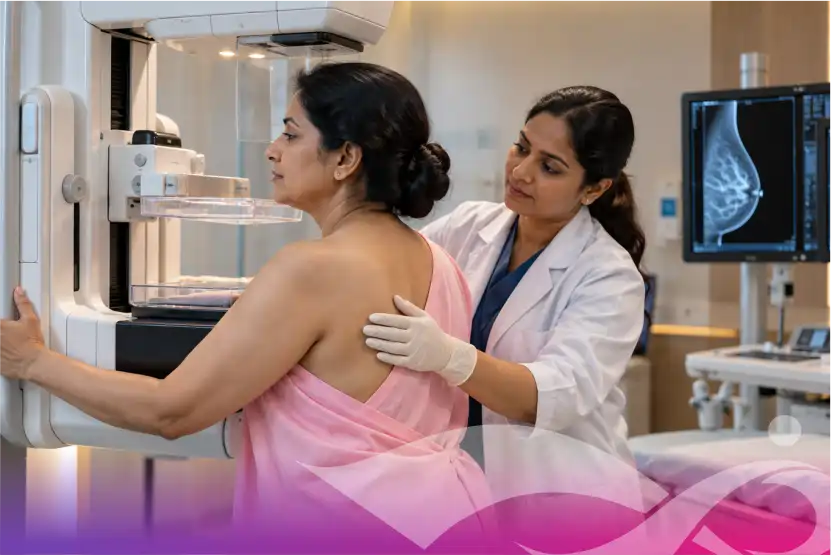
On a mammogram, dense tissue appears white. Some tumours also appear white. This overlap can hide, or “mask,” a small abnormality. Dense breasts are also linked with a modestly higher breast cancer risk compared with fatty breasts.
This does not make mammography useless. A mammogram remains the standard screening test for breast cancer and can detect early changes such as tiny calcium deposits that other tests may miss. For many women, density simply means the mammogram may need support from another test.
How Is Breast Screening Individualised?
There is no single plan for every woman with dense breasts. A breast specialist considers several factors together:
-
Your age and menopausal status
-
Family history of breast or ovarian cancer
-
Known genetic changes, such as BRCA mutations
-
Previous breast biopsies or abnormal findings
-
Past radiation therapy to the chest
-
Your breast density grade
This overall risk picture decides whether a mammogram alone is enough or whether extra imaging may help.
When May an Ultrasound Be Added?
Breast ultrasound uses sound waves to create images. It does not involve radiation. In dense breasts, an ultrasound can sometimes show small lumps that are hidden on a mammogram, which is why doctors may add it as a supplementary test.
Ultrasound has limits. It may pick up harmless findings that lead to extra scans or biopsies. It is also less effective at showing tiny calcifications. For this reason, it is usually used alongside a mammogram, not in place of one.
When May an MRI Be Considered?
Breast MRI uses magnets and a contrast dye to produce detailed images. It is highly sensitive, which makes it useful for selected higher-risk women, such as those with a strong family history, a known genetic mutation or previous chest radiation.
MRI is not a routine test for every woman with dense breasts. It is more expensive, needs an injection of contrast and may show findings that turn out to be benign.
Mammogram, Ultrasound and MRI: How Do They Compare?
A mammogram is the standard first-line screening test and is good at spotting calcifications, though density can reduce its clarity. An ultrasound adds a radiation-free second look that can help in dense breasts, with a higher chance of false alarms. An MRI offers the highest sensitivity and is generally kept for women with higher risk. Your doctor may recommend one test or a combination.
Which Cancer Screening Test Is Best for Women With Dense Breasts?
The answer depends on your personal risk. Which cancer screening test is best for women with dense breasts? For most women, a mammogram remains the base test. Ultrasound may be added for dense tissue, and MRI may be advised for those at higher risk. A specialist can decide what suits you.
Why Consider IOCI India for Breast Screening Guidance?
Many families search for the best breast cancer screening hospital in India when a report raises questions. What matters most is clear interpretation and a plan built around your risk. IOCI India has a 15-year legacy in oncology care and a network of cancer centres across cities including Noida, Greater Noida, Mumbai, Pune, Indore and Jodhpur. Its oncologists create personalised treatment plans, and complex cases can be reviewed through the International Tumor Board. Patients can also request a second opinion on existing reports.
When Should You Speak With a Breast Specialist?
Book a consultation if your report mentions dense breasts and you have a family history of breast cancer, a known gene mutation or past chest radiation. You should also seek prompt review for a new lump, nipple discharge, skin dimpling or changes in breast shape, even if a recent mammogram was normal.
Conclusion
Learning that you have dense breast tissue can feel worrying, but it is a common finding and not a diagnosis. The key is understanding your personal risk and choosing screening that fits it. If your report mentions breast density or you have concerns about your screening plan, consulting a qualified breast specialist can help you understand the right next step. For consultation and personalised guidance, you can connect with IOCI India. Bring your previous mammogram reports and family history details to your appointment.