



25 June 2026
Introduction
The two biggest obstacles to better cancer outcomes in India are late diagnosis and unequal access to specialist expertise. A patient in a tier-2 city presenting with an ambiguous pulmonary nodule on a chest X-ray faces a fundamentally different diagnostic pathway than one presenting at a large tertiary centre in Delhi or Mumbai, not because the disease is different, but because the radiological and pathological expertise required to interpret it reliably is concentrated in a small number of facilities.
This is where AI in cancer treatment has its most significant practical impact: not by replacing oncologists, but by making a reliable second opinion on a CT scan, a histopathology slide, or a genomic report available regardless of where the patient is. AI cancer detection tools trained on millions of annotated images can identify suspicious patterns with sensitivity comparable to expert radiologists, and they scale in a way that human specialists cannot. That is the clinical and public health case for AI in Indian oncology, and it is more concrete than the general language of "transformation" usually conveys.
Overview: What AI Actually Does in Oncology
Artificial intelligence in cancer care is not a single technology it is a category of tools with distinct functions at different stages of the cancer pathway. Computer vision algorithms analyse medical images mammograms, CT scans, MRIs, and histopathology slides to flag suspicious findings for radiologist or pathologist review. Natural language processing extracts relevant clinical information from unstructured records. Machine learning models trained on genomic and clinical datasets predict treatment response and disease progression.
Each of these addresses a specific bottleneck in the diagnostic or therapeutic pathway, and their combined effect on a well-integrated oncology programme is measurable in earlier-stage diagnoses, reduced time to treatment, and more accurately matched therapies. Hospitals integrating these tools across the pathway not just in one department, represent what a modern oncology hospital in India is increasingly expected to provide.
Key Applications of AI in Cancer Detection and Treatment
AI-assisted imaging
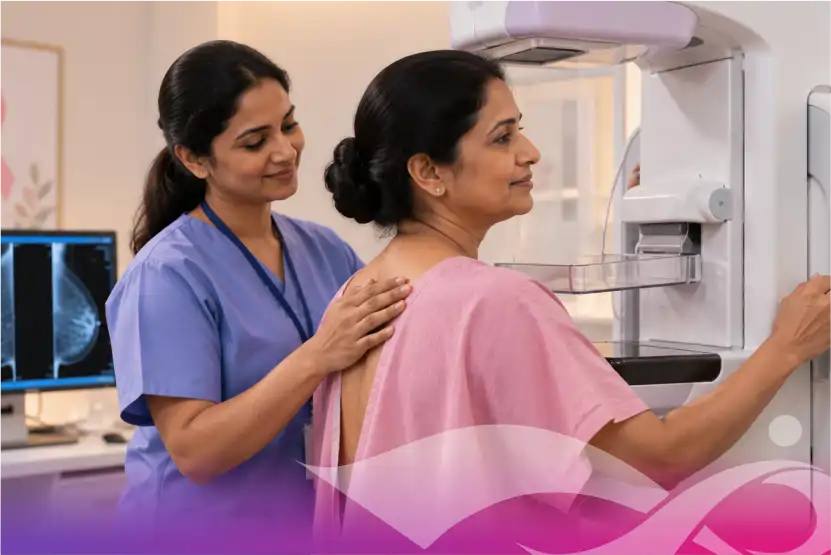
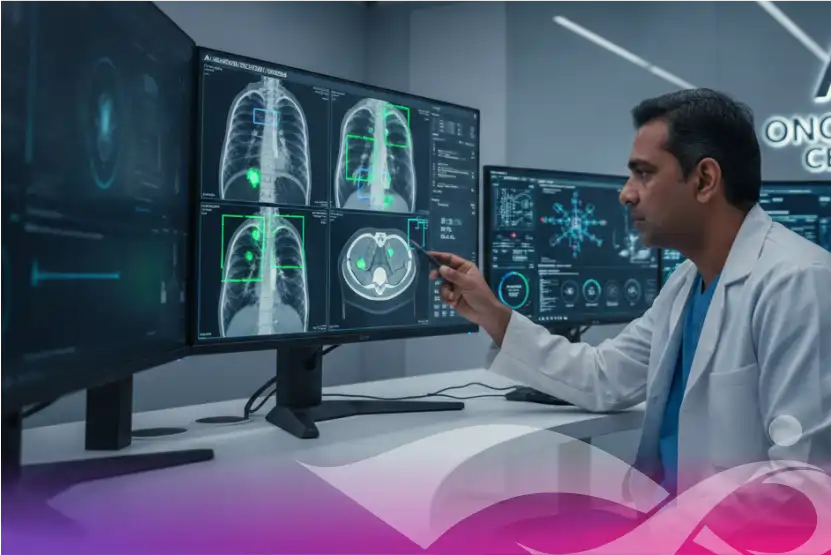
AI cancer diagnosis has its strongest evidence base in imaging. FDA-cleared and CE-marked algorithms now exist for mammography, lung nodule detection on CT, diabetic retinopathy, and colonic polyp identification on colonoscopy several of which are directly relevant to cancer screening.
In India's context, these tools address the radiologist shortage the country has approximately 12,000 radiologists serving a population of 1.4 billion, compared to recommended ratios that would require ten times that number. An AI system that flags high-priority findings for human review does not replace the radiologist it allows each radiologist to function at the top of their capability rather than spending time on normal studies.
Pathology and genomic analysis
Digital pathology, the analysis of whole-slide images by AI algorithms is one of the most significant advances in oncology diagnostics. AI models can classify tumour subtypes, grade malignancies, identify actionable mutations in tissue morphology, and predict molecular features from standard haematoxylin and eosin stains without requiring additional tests.
This approach is particularly relevant for predictive biomarkers identifying patients likely to respond to checkpoint inhibitors or targeted therapies from the diagnostic biopsy, rather than requiring separate molecular testing that adds time and cost. Combined with next-generation sequencing interpreted through machine learning, these findings constitute the diagnostic foundation of precision oncology.
Treatment planning and radiation delivery
Radiation therapy planning involves precisely delineating tumour volumes and organs at risk a manual process that takes hours per patient when done by a clinical oncologist. AI-assisted auto-contouring reduces this to minutes, with accuracy comparable to expert human delineation for most tumour sites.
Adaptive radiotherapy systems using AI can also adjust treatment plans between fractions based on daily imaging, accounting for tumour shrinkage or positional changes in real time. The practical outcome is better tumour coverage with a reduced normal tissue dose, which translates directly into reduced toxicity and improved tumour control.
Precision oncology and treatment matching
AI in cancer examination shows perhaps its most direct patient benefit in treatment matching. Molecular tumour boards where genomic sequencing results are reviewed against databases of targetable alterations and clinical trial evidence are increasingly AI-assisted, with algorithms that can cross-reference a patient's full genomic profile against thousands of clinical trials, drug labels, and published evidence in seconds. For patients with rare tumours or refractory disease, this systematic approach to matching identifies options that would not surface through manual literature review. It is one of the clearest examples of AI genuinely expanding the treatment options available to an individual patient rather than simply making an existing process faster.
Predictive analytics and monitoring
Machine learning models trained on longitudinal clinical data can predict which patients are at highest risk of disease recurrence, treatment-related toxicity, or hospital readmission. This shifts oncology follow-up from a fixed schedule applied uniformly to all patients toward risk-stratified monitoring more intensive surveillance for high-risk patients and less resource-intensive for low-risk ones. In a healthcare system under capacity pressure, allocating clinical attention to where it is most needed yields measurable efficiency and outcome benefits.
AI in the Indian Oncology Context
India's cancer burden, which includes approximately 1.46 million new cases annually and is rising, intersects with structural challenges that AI can specifically address. Diagnostic delay remains the primary driver of late-stage presentation: the median interval between symptom onset and diagnosis in India is significantly longer than in high-income countries, partly due to limited specialist access at primary and secondary care levels.
AI-powered screening tools that can run on standard hardware and be operated by trained non-specialist health workers extend screening capability to settings where specialist radiologists and pathologists are not present. Teleoncology platforms that integrate AI diagnostic support allow specialist oncologists at a modern oncology hospital, India, to effectively review AI-flagged findings from remote sites, distributing specialist expertise without relocating the specialists. This approach is the application of AI with the greatest potential to change outcomes at a population scale in India, and it is already operational in several state-level cancer screening programmes.
Why Choosing an AI-Integrated Cancer Centre Matters
The clinical value of AI in oncology is realised only when it is properly integrated into the workflow, not installed as a standalone system that produces outputs that nobody looks at. Centres providing advanced cancer care that Delhi NCR patients rely on are distinguished by the quality of clinical AI integration, AI findings reviewed by qualified specialists, AI-supported tumour boards where genomic data is actually used in treatment decisions, and radiation planning systems where AI auto-contouring is validated against expert review before clinical use. The technology itself is available from multiple vendors; the quality of implementation and the expertise of the clinical team interpreting AI outputs are what determine whether a patient benefits from it. When evaluating oncology facilities and asking specifically about which AI tools are in clinical use, not pilot stages, and how AI findings are reviewed and acted on provides a more informative picture than facility size or equipment lists alone.
Expert Tips for Patients Navigating AI-Enhanced Cancer Care
-
Ask whether AI-assisted analysis was used in your imaging or pathology report — this process is increasingly common at specialist centres; knowing it was used and that a qualified specialist reviewed and validated the AI findings should be part of your informed consent to diagnostic workup.
-
Request molecular profiling if you have a solid tumour and standard treatment has failed or is unlikely to work — AI-assisted genomic interpretation is most valuable in this setting, and the cost of sequencing has fallen enough that it is now accessible at most major cancer centres.
-
Enquire about clinical trial eligibility at the first consultation — AI-assisted trial matching identifies eligibility criteria that manual review misses; a centre without this capability may not surface trials for which you qualify.
-
Do not mistake AI-generated outputs for clinical decisions — AI tools produce findings that require specialist interpretation; a report flagged by an algorithm is a starting point for clinical assessment, not a diagnosis.
-
Attend all scheduled follow-up imaging even if you feel well — predictive models that identify recurrence risk are based on imaging data; skipping follow-up scans removes the input that AI-assisted surveillance depends on.
-
Seek advanced cancer care Delhi NCR facilities that can demonstrate clinical outcomes, not just technology adoption — ask about the centre's five-year survival rates by stage and tumour type; AI integration that produces better outcomes will show in clinical data, not just equipment brochures.
-
Understand that AI in oncology is a support tool, not a replacement for multidisciplinary expertise — the best outcomes consistently come from treatment decisions made by a full multidisciplinary team using AI as one input, not from AI-generated recommendations followed without clinical review.
Conclusion
The integration of AI in cancer checkups and diagnosis into Indian oncology is neither a future aspiration nor a marketing claim. At the best centres, operational clinical infrastructure is changing how cancers are found, staged, and treated. The practical benefits are measurable: earlier-stage detection through AI-assisted screening, more accurate pathological classification, better-matched therapies through genomic analysis, and safer radiation delivery through automated planning. For patients, the most important implication is that choosing a modern oncology hospital in India that has genuinely integrated these tools, not just acquired them, and provides advanced cancer care that Delhi NCR residents can access with full multidisciplinary support, is a decision that affects not just the quality of the experience but the clinical outcome. In oncology, the combination of skilled clinicians and well-implemented AI produces results that neither achieves alone.