




21 August 2026
Many women put off learning breast self-checks because it feels awkward, or they assume it's something only a doctor should do. It isn't complicated, and it genuinely helps. The question we hear most in the clinic is simple, how do I check for breast cancer myself, at home, without overthinking it?
Why Self-Checks Matter
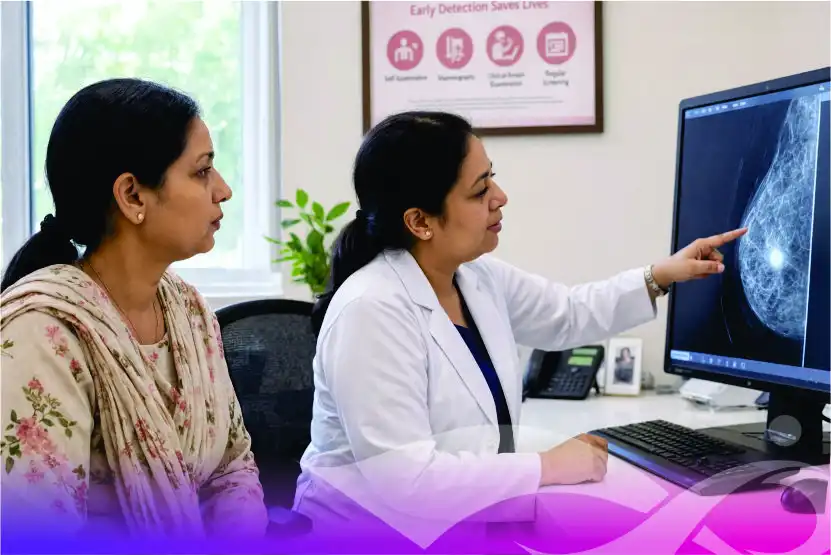
Self-examination isn't a replacement for breast cancer screening in Noida through mammograms, but it builds familiarity with what's normal for your own body, so changes stand out faster. Most breast lumps found by women themselves turn out to be benign, but catching a genuine change early still makes a real difference in outcomes.
Doing a self-exam once a month, ideally a few days after your period ends when breast tissue is least tender, is enough to build a useful baseline over time. For women who've gone through menopause, picking a fixed date each month works just as well, since there's no cycle to anchor the timing to anymore.
What to Actually Look and Feel For
Stand in front of a mirror and search for visible changes in dimpling, puckering, nipple retraction, or any skin texture that looks different from before. Then, lying down, use the pads of your fingers to feel each breast in a circular pattern, moving from the outer edge inward, covering the whole breast and armpit area. Applying light, medium and firm pressure in turn during this check helps you feel tissue at different depths, since a lump can sometimes sit deeper than a light touch alone would catch.
Look and feel for a new lump, thickening, unusual discharge, or persistent pain in one specific spot. A little unevenness between breasts is normal for most women; what matters is a distinct, new change from your baseline.
How This Fits into Regular Screening
Self-checks work best alongside, not instead of clinical screening. Women's Cancer Care guidelines generally recommend a clinical breast exam every one to three years starting in your twenties, and annual mammograms typically start around age 40, or earlier with a family history of breast cancer.
If you notice anything unusual during a self-check, the next step is a clinical exam and, if needed, imaging like a mammogram or ultrasound to look closer.
Risk Factors Worth Being Aware Of
Self-checks matter more for some women than others, depending on a few known risk factors.
Family History and Genetics
A first-degree relative, mother, sister or daughter with breast cancer roughly doubles a woman's own risk. Certain inherited gene mutations, like BRCA1 and BRCA2, raise the risk considerably further and often call for earlier, more frequent screening.
Lifestyle and Hormonal Factors
Long-term hormone therapy, later childbirth or no childbirth, obesity, and higher alcohol intake are all associated with a modestly increased risk. None of these factors guarantee that cancer will develop, but they provide useful context for a doctor when deciding how often you should be screened.
Why Choose IOCI for Breast Health
IOCI's approach to breast health awareness combines screening, diagnosis and treatment under one coordinated system, recognised as one of the go-to names for the best breast cancer hospital in Noida. Suspicious findings move quickly from imaging to biopsy to tumor board discussion, without long gaps between each step.
This matters because anxiety often builds while women wait for answers. A streamlined process, from first concern to confirmed diagnosis or reassurance, reduces that waiting period considerably.
Tips for Building a Consistent Habit
A few small habits make self-checks easier to stick with:
-
Pick the same time each month, a few days after your period ends
-
Use a consistent method, circular motion, so you notice changes reliably over time
-
Check both lying down and standing in front of a mirror
-
Note anything unusual, even if you're not sure it's significant
-
Don't wait for your next annual check-up if something feels genuinely different
Conclusion
Breast self-examination takes a few minutes and costs nothing, yet it's one of the simplest ways to stay ahead of changes in your body. Pair it with regular clinical screening, and you will be well prepared. IOCI's women's cancer care team in Noida offers screening and consultation for anything that feels worth checking further, and there's no such thing as too small a concern to bring in.